
Your Achievements


Next /
Sign inSign in to Community to gain points, level up, and earn exciting badges like the new Applaud 5 BadgeLearn more!
View All BadgesSign in to view all badges
email script token not working
Topic Options
- Subscribe to RSS Feed
- Mark Topic as New
- Mark Topic as Read
- Float this Topic for Current User
- Bookmark
- Subscribe
- Printer Friendly Page

Anonymous
Not applicable
10-11-2016
06:22 AM
- Mark as New
- Bookmark
- Subscribe
- Mute
- Subscribe to RSS Feed
- Permalink
- Report Inappropriate Content
10-11-2016
06:22 AM
Hi friends,
I'm writing a script token that removes the domain extension (like ".com" or ."org") of an email address before displaying the result whenever called from a flow.
It's not working. Perhaps I've done something wrong here. Please can anyone help?
set ($leadEmail=${lead.Email})
set ($fiveLetterEnding = [".co.uk", ".co.jp", ".co.za"])
set ($fourLetterEnding = [".info", ".name", ".mobi"])
set ($threeLetterEnding = [".com", ".net", ".edu", ".gov", ".org", ".biz"])
set ($twoLetterEnding = [".fr", ".be"])
If ($leadEmail.matches("^[A-Z0-9._%+-]+@[A-Z0-9.-]+\\.[A-Z]{2,6}$"))
foreach ($fiveLetterEnding)
if ($leadEmail.matches("^$fiveLetterEnding"))
$leadEmail=$leadEmail.substring(0, 4)
end
end
foreach ($fourLetterEnding)
if ($leadEmail.matches("^$fourLetterEnding"))
$leadEmail=$leadEmail.substring(0, 3)
end
end
foreach($threeLetterEnding)
if ($leadEmail.matches("^$threeLetterEnding"))
$leadEmail=$leadEmail.substring(0, 2)
end
end
foreach($twoLetterEnding)
if ($leadEmail.matches("^$twoLetterEnding"))
$leadEmail=$leadEmail.substring(0, 1)
end
end
end
8 REPLIES 8


- Mark as New
- Bookmark
- Subscribe
- Mute
- Subscribe to RSS Feed
- Permalink
- Report Inappropriate Content
10-11-2016
09:31 AM
Need more than "not working" -- actual behavior and errors. And definitely note Greg's follow-up.
I'll say straight away that what you've pasted isn't valid Velocity (VTL) code, since the lines don't begin with '#'. (The way you're doing the parsing is also way too verbose -- if you're hard-coding the small list of domains you care about, you only need one line to trim to trim all such values.)
Anonymous
Not applicable
10-12-2016
02:31 AM
- Mark as New
- Bookmark
- Subscribe
- Mute
- Subscribe to RSS Feed
- Permalink
- Report Inappropriate Content
10-12-2016
02:31 AM
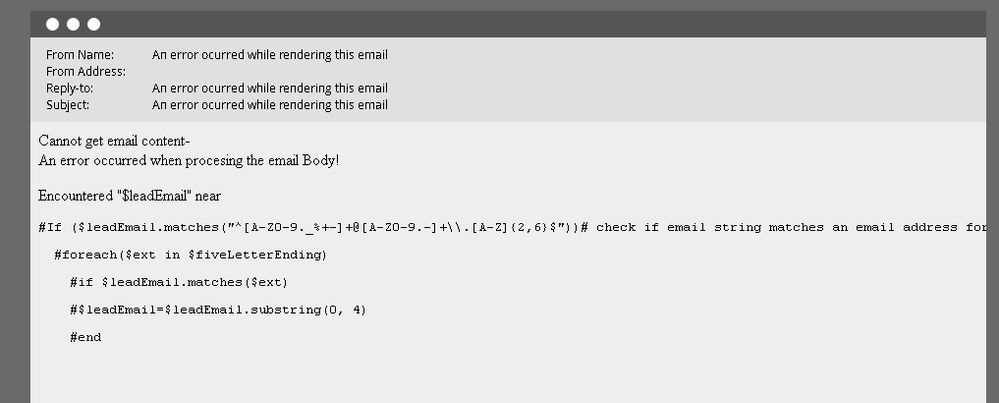
Anonymous
Not applicable
10-12-2016
02:26 AM
- Mark as New
- Bookmark
- Subscribe
- Mute
- Subscribe to RSS Feed
- Permalink
- Report Inappropriate Content
10-12-2016
02:26 AM
Thanks Sanford, I think i'm still doing something wrongly. Please would you know any ways of making this code simpler and less verbose?


- Mark as New
- Bookmark
- Subscribe
- Mute
- Subscribe to RSS Feed
- Permalink
- Report Inappropriate Content
10-11-2016
07:37 AM
HI Kenneth,
what do you mean by:
"before displaying the result whenever called from a flow"
?
Velocity tokens only render in emails. If you were trying to use it as a new value in a flow step, for instance, it would not work.
-Greg
Anonymous
Not applicable
10-12-2016
02:17 AM
- Mark as New
- Bookmark
- Subscribe
- Mute
- Subscribe to RSS Feed
- Permalink
- Report Inappropriate Content
10-12-2016
02:17 AM
I'm very sorry for my late reply.
Actually, I wanted to build a simple campaign that assigns company names to leads that have no company data but have an email address with their company's official domain like "......@microsoft.com".
So the aim is to trim off "......@" and ".com" to have just "microsoft" and in the flow of this campaign, I plan to call an email script token like "my.companyName" so that I have Company Name = "my.companyName".
The script above was supposed to ronly remove ".com" from the email address but didn't work. Perhaps I am doing something wrong
- Mark as New
- Bookmark
- Subscribe
- Mute
- Subscribe to RSS Feed
- Permalink
- Report Inappropriate Content
10-12-2016
10:31 AM
Actually, I wanted to build a simple campaign that assigns company names to leads that have no company data but have an email address with their company's official domain like "......@microsoft.com".
Email scripts can't update lead fields. They are used to display custom content in an emails, but they do not write content back to the database.
Anonymous
Not applicable
10-13-2016
05:26 AM
- Mark as New
- Bookmark
- Subscribe
- Mute
- Subscribe to RSS Feed
- Permalink
- Report Inappropriate Content
10-13-2016
05:26 AM
Thank you Sanford. I was initially thinking of downloading company names of leads and trimming off the unwanted strings with excel. Perhaps I'll just do that
- Mark as New
- Bookmark
- Subscribe
- Mute
- Subscribe to RSS Feed
- Permalink
- Report Inappropriate Content
10-13-2016
03:33 PM
If you have a distinct set of string matches that you're interested in, a FlowBoost script can do this easily:
var PUBLIC_SUFFIXES = [".co.uk", ".co.jp", ".co.za", ".info", ".name", ".mobi", ".com",
".net", ".edu", ".gov", ".org", ".biz", ".fr", ".be"],
COMPANY_MAPPINGS = {
"microsoft, ms": "Microsoft Corporation",
"fortinet, fnet": "Fortinet",
"cisco, linksys": "Cisco Systems"
},
leadEmail = {{Lead.Email Address}}
emailInferredCompany = getInferredCompany(leadEmail);
function getInferredCompany(email) {
var RE_PUBLIC_SUFFIXES = new RegExp('(@|\\.)(\\w*)(' + PUBLIC_SUFFIXES.map(reEscDomain).join('|') + ')$', 'i'),
suffixMatch = (leadEmail.match(RE_PUBLIC_SUFFIXES) || [])[2],
companyMatch;
if (suffixMatch) {
Object.keys(COMPANY_MAPPINGS).forEach(function(mappingKey) {
var RE_COMPANY_MAPPING = new RegExp('^(' + simpleListToArray(mappingKey).join('|').trim() + ')$', 'i'),
mappingValue = COMPANY_MAPPINGS[mappingKey];
if (suffixMatch.match(RE_COMPANY_MAPPING)) {
companyMatch = companyMatch || suffixMatch.replace(RE_COMPANY_MAPPING, mappingValue);
}
});
}
return companyMatch || "";
}
function reEscDomain(dnsDomain) {
return dnsDomain.split('.').join('\\.');
}
function simpleListToArray(list) {
return list.split(/\s*,\s*/).reduce(function findEscCommas(prev, next) {
if (prev.length && prev[prev.length - 1].match(/\\$/)) {
return prev.concat(prev.pop().replace(/\\$/, ',' + next));
} else {
return prev.concat(next);
}
}, []);
}
But I would caution that this approach is going to have a bunch of false positives. I have a @microsoft.com address, for example, but I don't work for Microsoft.
- Copyright © 2025 Adobe. All rights reserved.
- Privacy
- Community Guidelines
- Terms of use
- Do not sell my personal information
 Adchoices